
This Means War [solo playtest]
I gave a spin to the new game by the author of Microscope

“This Means War” is a fresh game by Ben Robbins, and is now out, freely distributed for playtesting: https://lamemage.itch.io/this-means-war-playtest.
The game simulates war and the characters caught up in it. You don’t control the war, which evolves on its own, but you control the characters involved in it.
I decided to play this game for some world building: Let’s figure out a past war in my solo hexcrawl campaign based on Into the Odds + Into the Deep Country.
Setup of the two nations at war
We start by rolling for the characteristics of the two countries at war:
Both were preparing for war
Country One: Past grievance with Country Two
Country Two: Weak industry
Alright, so Country One needs to be Bastion, the megacity-based nation of Into the Odds, which I see a sort of London in the (weird) 1800s, with an imperial thirst for exploration and trade. Here, the Institutes of Geography are militaristic organizations, and the army members are called geographers.
Country Two is Gurak Abut, a mountain kingdom with a generally low tech level. The past grievance" of Bastion is that Gurak Abut, with the aim of protecting its economy, closed his borders and commercial routes.
Setup of the war theaters
For each country we need to come up with two areas/regions, with one of them being the shadow of war, i.e., close to being directly involved. Bastion:
[Shadow of war] Sector 19K: Rural maritime region in the Deep Country with fishing villages and lots of small islands
Mills of the Veragan Dams, Lake region not far from Bastion with lots of hydromechanical mills
Gurak Abut:
Mines of Shebal Payyum: Copper and iron, low quality
[Shadow of war] Cotrosca coast: Massive production of olive oil, the only access Gurak Abut has to the sea,
After this, we have to set up three other regions that are war fronts, i.e., not controlled by any of the two countries and at great risk of being involved in the war.
And at this point, I have zero ideas and would really need a spark table. Even better: Random tables for country description in terms of government, economy, etc. I use random tables from Mythic 2 (Tana Pigeon, World Mill Games) and get:
Guascal Badlands: Ruled by local violent warlords, target for proxy wars
Bulum Valley: Jungle and rivers, small independent theocracy with semi-autonomous monasteries administrating villages and cities nearby; confines with Gurak Abut
Arghawat Region: Steppe with nomad people, borders with the Deep Country of Bastion
The war breaks out!
Wait, who’s the good guy here? None of them: “Nations do not have friends, only interests” (Charles De Gaulle); and “There are no good powers” (Fabrizio De André).
Season roll: Summer. I decide Bastion is the attacking nation, they have that grievance, after all. Casus belli roll: They are preparing to attack us. Oh oh oh!, I can see the Bastion newspaper titles already.
Next, we roll the nations’ stats:
Bastion Will 12; Resources 9; Position 2
Gurak Abut Will 9; Resources 7; Position -2
Front location roll: Bulum Valley (the jungle theocracy, see above)
Roll for the nation moves (Bastion has the initiative):
Bastion: Surprise attack! The geographers march into the jungle with muskets, hatchets, cannons, baggage carts, and a generous supply of cheap Marvel John’s honey crunchy bars. They see the theocracy as an easy, underdeveloped prey. From there, they can invade the mountains of Gurak Abut, at the same time cut its main land trade routes.
Gurak Abut: Diplomacy (Rolled as a response to Bastion). They send stern ultimatums about the sacredness of their borders, while helping to the Bulum Valley resistance.
From geopolitics to individual stories
After finding what the nations do, the game asks to introduce our character. Our man Saigarth, at the time of the war, is just a Calibrator with his shako military cap (think at a French or Russian grenadier). We also need to secretly decide if he wants war or peace. I would say he’s the kind of guy who just wants to do his job without being bothered. Not a thrill seeker. So yeah, he would rather have peace than having his ass on the line.
How does the attack go?
After the character introduction, we roll the outcome of the season. Bastion rolls with a lot of advantages, but they are capped at 3 dice with advantage: (5, 3, 2).
Gurak Abut, even if weaker, still ends up rolling 3 dice: (7, 8, 7), and wins! The jungle is a tougher terrain than expected; the locals rally behind their religious fervor and know the terrain very well; advances are slow and exposed to frequent guerrilla attacks. The nation stats are modified based on who wins and each nation’s tactical choice:
Bastion Will 12; Resources 7; Position 1
Gurak Abut Will 10; Resources 6; Position -1
What happens to our character?
We roll for Saigarth and we find he is in danger. The outcome is a tough decision: Kill someone or risk death. Now, I’ll be honest, I like this game so far but I do not like how this outcome plays. I think the intention is to provide a morally difficult decision, but it reads… artificial? Imposed? Too guided? Other outcomes are more straightforward, and not choices. In our case, Saigarth is surprised by a night assault from the local resistance. He is a soldier so yes, he does not hesitate to use his musket to kill people. And having chosen to kill, he does not roll on the Refuse to kill table.
Autumn comes
New season! Battleground roll: No changes. Roll for nation moves (none has the initiative):
Bastion: Retreat and regroup
Gurak Abut: Foreign aid. Roll for the aid: The Arghawat Region. Gurak Abut is using religious zeal (and a copious amount of gold) to convince the nomads to raid the Bastion border.
Then we go to our character, and play two scenes (it would be a bit more dynamic with 2+ players):
Saigarth is smoking his pipe under the shade of a tree covered in moss and vines, closing his eyes in the humid heat of the jungle. He takes off his boots and hat and places them on the wet grass. He is still smoking the high quality tobacco he brought from home.
Saigarth is ankle deep in the mud of the dark jungle, the rain is pouring, the battle is all around him. He is lost. He seems to hear the order to advance, but towards which direction? It’s hard to see if the screaming figures moving around him are companions or enemies. He hears sparse bangs: Muskets are unreliable under the rain. He makes a vow: “If I survive this war, I will give up tobacco.” He thinks it’s kind of a good deal because the good tobacco is now gone, and the cheap one provided by the army is soaked wet and unsmokable.
How does the war evolve? Based on stats and modifiers, Bastion rolls three dice with advantage (1, 5, 5), while Gurak Abut rolls two with advantage (5, 7) and wins again!
Bastion Will 12; Resources 7; Position -1
Gurak Abut Will 10; Resources 6; Position 1
Bastion partially retreats from the valley and fortifies its positions, as fresh troops do not arrive, beacause they are sent to deal with the nomads of Arghawat.
Finally, we roll for what happens to Saigarth: He gets seriously wounded and will be out of the game for at least one season. He survives, and gives up smoking! Hell, I am actually using this to justify why Saigarth does not smoke in the hexcrawl story.
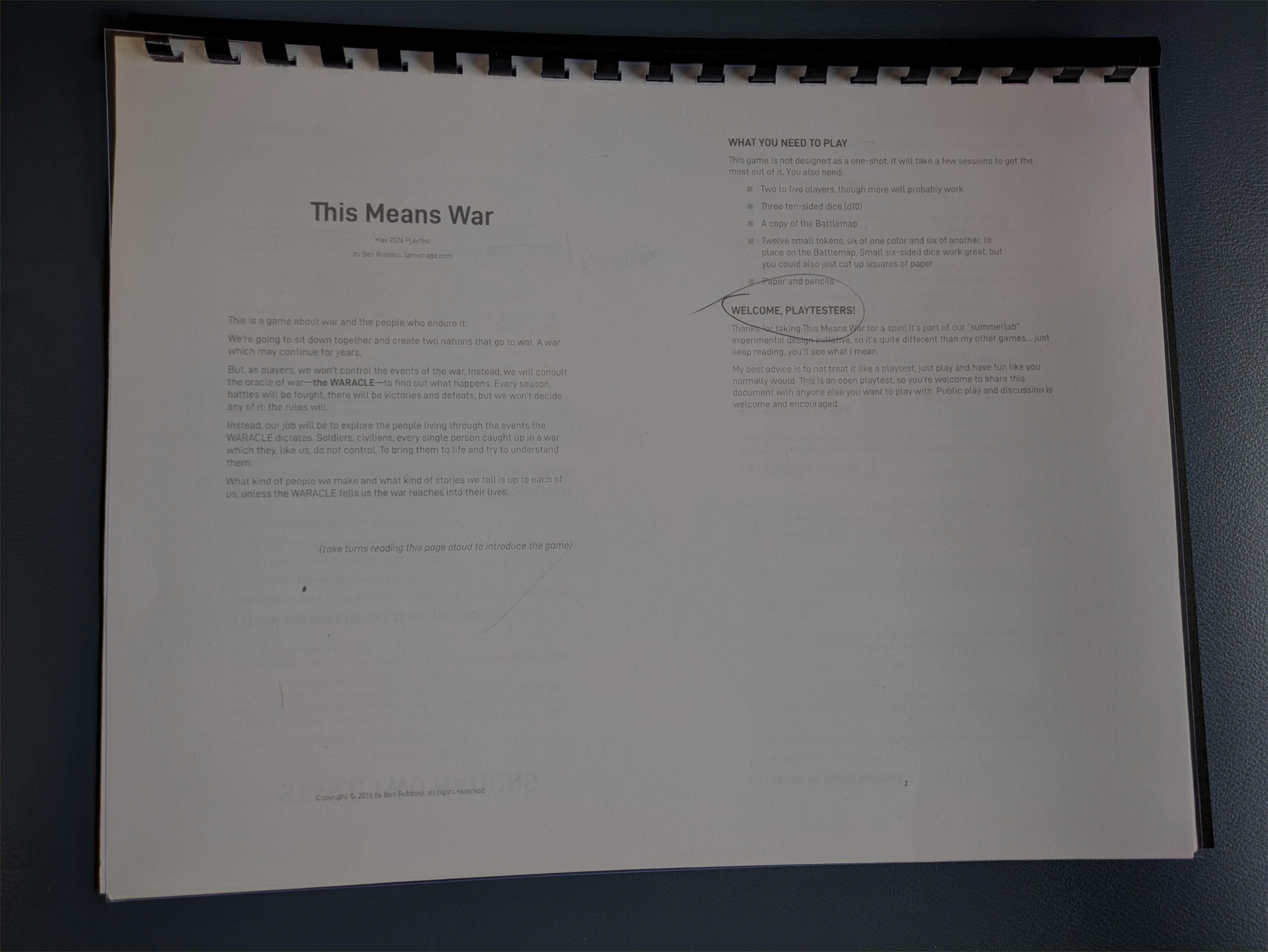
I will stop here as this post is already longer than I wanted it to be, but I will go on playing the war. Also, please consider this is just a playtest version, and not the final game.
Did the game work? Was it useful for my campaign?
In short, yes and yes. It gave me the much needed framework to world-build and play the war, and greatly helped me define the political geography of the setting.
With minimal changes, this game could become a war simulator for my campaigns (no matter the game). In TTPRGs the rules for wars are often close to wargaming: I mean, you get to do logistics and details such as the equipment of different sections of the army; morale; etc. With some modifications, this system could present a more abstract and narrative alternative, which I would welcome, because it is something really missing in the TTRPG space.
Things I would add and change when playing again
Add a generic spark table with descriptors.
Add random tables for Country descriptors (government, economy, geography, society). Ideally, this should be blended with the nation traits you roll at the beginning.
Add a flowchart to visually explain the game loop, so it’s easier to follow.
“We should not pick a side we want to wind”, says the handbook on page 3. I just find it wrong. If you want a side to win, why not? It’s your story.
The game seems to be designed for wars among nations with similar forces. I would love also to have strongly imbalanced forces instead; like planning ahead a scenario instead of going random in terms of strengths, resources, etc. Many times wars are coin toss, many times they are not. I still find that interesting to play.
Rework the “Kill someone or risk death” outcome into two distinct outcomes: 1. you kill someone (I mean, still kind of heavy) and 2. You risk death.
PS If you are curious about the solo Into the Odds + Into the Deep Country solo hexcrawl, here is how it starts (it involves prompts from Bruce Springsteen):
![My best was never good enough [Into the Odd/Into the Deep Country solo actual play]](https://substackcdn.com/image/fetch/$s_!xgyC!,w_140,h_140,c_fill,f_webp,q_auto:good,fl_progressive:steep,g_auto/https%3A%2F%2Fsubstack-post-media.s3.amazonaws.com%2Fpublic%2Fimages%2F08e17c3e-a6b8-4bee-b9f9-489504a6a354_647x476.png)
Here the last episode:
![A tour of the Blightwick Penitentiary [solo Into the Odd + Into the Deep Country actual play]](https://substackcdn.com/image/fetch/$s_!Q7cr!,w_140,h_140,c_fill,f_webp,q_auto:good,fl_progressive:steep,g_auto/https%3A%2F%2Fsubstack-post-media.s3.amazonaws.com%2Fpublic%2Fimages%2Fd72be8c0-f4be-48b3-8998-177bd3162908_988x493.png)
The using it as part of your campaign is the kind of stuff I love and I think that's the big problem. This isn't a game it itself is a table of a sorts. Oh sure you could play it as written, you can imbrace the matrix of choices it presents but in many ways then your not playing a wargame but a sort of board game not unlike life where the binary choice tries to convince you that it's not just gambling.
And so I say you've convinced me to give it a look. Just to see if Kill or Risk Death is in fact even a choice worth making.
I sit here and think that within the broader context of war the odds that an individual would ever chose the later would be increasingly small.
But if the game if the campaign where to become you must kill someone on your side or you must risk your own death then we have a heck of a fun game even if it is a binary choice we kind of have to force. The player will still almost always chose to not risk death but then we can explore the why after. It is when we follow rigid procduralism that we stop playing the war game.
Following the presentation of two initial states players/powers should go what part of the DIME can I lean on to produce the outcome that maximizes my return on either gamble even if my actual action is a third option revealed within the shared cognitive space that we could call the field of battle/play.
Is faking someones death killing them? I would argure to a degree and thus we could in theory define the odds of success the risk of things going bad if caught to what degree and so forth but each of this subsequent judgements requires a certain understanding.
If the game fails to provide meaningful choice it's just gambling. If the gamble itself doesn't even matter it's just weather.
Just my two cents on what you wrote about given what I've been thinking about about 'campagins' of late. Feel free to ignore my rambeling. Point is you got me thinking.